Pole Barn vs. Stick-Built Garage: Which Is Right for You?
A head-to-head comparison of post frame (pole barn) and conventional stick-built garages covering cost, construction speed, durability, and best use cases.
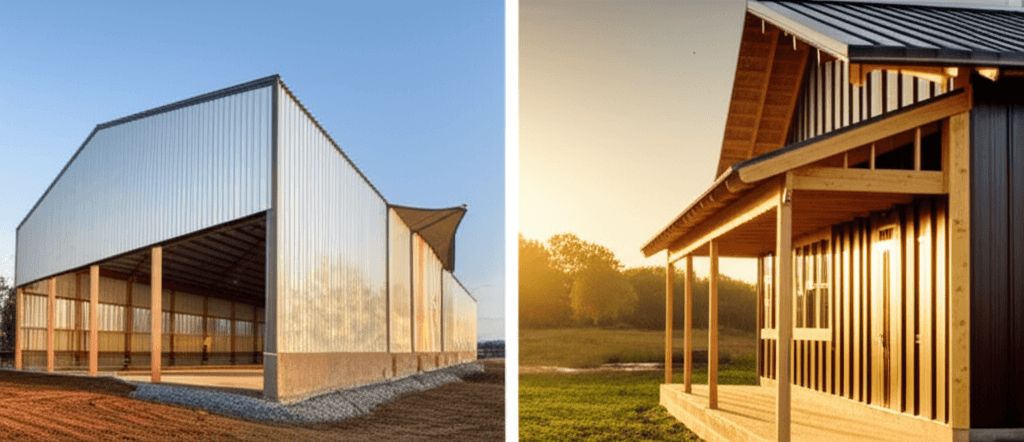
Two Approaches to the Same Goal
You need a garage. Maybe it is a two-car for daily drivers and a workbench. Maybe it is a three-car with a lift and a lofted storage area above. Either way, you are going to build a structure — and the first decision is what kind.
The two most common construction methods for detached garages in the United States are post frame (commonly called pole barn) and conventional stick-built (wood stud framing). Both can produce a great building. But they differ significantly in cost, speed, structural approach, and best applications.
This guide breaks down the real differences so you can make an informed decision.
What Is Post Frame Construction?
Post frame construction uses large, widely spaced columns (typically pressure-treated wood, set 6 to 8 feet apart) embedded in the ground or mounted on concrete piers. Engineered roof trusses span the full width of the building between columns, creating a clear-span interior with no interior load-bearing walls or posts.
The walls are non-structural — they are simply attached to the columns as an envelope. Steel panels are the most common wall and roof material, though post frame buildings can also use conventional siding, brick, stone, or any other finish.
What Is Stick-Built Construction?
Stick-built (or conventional framing) uses 2x4 or 2x6 studs spaced 16 inches on center to create load-bearing walls. Roof trusses or rafters sit on top of these walls. The walls carry the roof load down to a continuous concrete foundation.
Stick-built construction is the standard method for homes, attached garages, and many commercial buildings.
Head-to-Head Comparison
Cost
This is where post frame shines. A 30x40 post frame garage package starts around $18,900 for materials. A comparable stick-built garage runs $30,000 to $45,000 for materials and labor.
The savings come from several factors:
- Fewer foundation points. Post frame needs individual column footings or embedded columns, not a continuous perimeter foundation.
- Fewer materials. Widely spaced columns and steel panel walls use far less lumber than stud walls.
- Faster erection. Less labor time means lower labor costs (or less time invested if you are doing it yourself).
- No sheathing or housewrap. Steel panels are the structure and the weather barrier in one.
For a typical project, post frame construction costs 30 to 50 percent less than comparable stick-built construction.
Construction Speed
A post frame garage can be erected in 2 to 5 days by a small crew (2 to 4 people). The process is straightforward: set columns, install trusses and purlins, hang steel panels, install doors and trim.
A stick-built garage takes 2 to 4 weeks for a framing crew, plus additional time for roofing, siding, and trim contractors.
If you are building it yourself, the time difference is even more dramatic. Post frame construction is specifically designed for efficient erection — the components are larger and fewer, and the assembly sequence is linear.
Clear-Span Interior
Post frame wins decisively here. Because the columns carry all the loads, the interior is completely open. No interior posts. No load-bearing walls. You can park equipment anywhere and reconfigure the space at will.
Stick-built garages wider than about 24 feet typically require an interior bearing wall or beam to support the roof trusses, which limits your floor plan flexibility and can interfere with vehicle parking.
Foundation Requirements
Post frame buildings can be built on gravel, compacted fill, or concrete — or with no floor at all (bare ground works for many agricultural applications). The columns are the foundation, whether embedded in the ground or bolted to concrete piers.
Stick-built garages require a continuous concrete foundation — either a monolithic slab (slab on grade with thickened edges) or a perimeter footing with a separately poured slab. In cold climates, the footing must extend below the frost line, which can mean 36 to 48 inches of concrete below grade.
This difference alone can save $5,000 to $15,000 on a post frame project.
Insulation and Energy Efficiency
Stick-built advantage. Stud walls create natural cavities for batt insulation, and the sheathing layer provides an easy surface for housewrap and continuous insulation. Achieving a tight building envelope is straightforward with stick-built methods.
Post frame buildings can be insulated effectively, but it requires more intentional detailing. The most common approach is spray foam between columns, or hanging a vapor barrier and using batt insulation with interior liner panels. Metal buildings are prone to condensation if not insulated properly, but with the right approach they can match or exceed stick-built energy performance.
If you plan to heat and condition your garage year-round, factor insulation into your budget and planning regardless of construction method.
Aesthetics and Finishing
Stick-built advantage for traditional residential aesthetics. If your garage needs to match your home with lap siding, brick, or stucco, stick-built is the more natural choice. The stud wall system accommodates any exterior finish.
That said, post frame buildings have come a long way from the plain metal barn look. Modern post frame garages use color-matched steel panels with trim details, wainscot finishes, and design elements that rival conventional construction. Many new post frame garages are virtually indistinguishable from stick-built at first glance.
Interior finishing is similar for both methods. Both can accommodate drywall, OSB, plywood, or metal liner panels.
Durability and Longevity
Both methods produce durable buildings when properly engineered and constructed. Post frame buildings have been standing for decades across the agricultural Midwest without issue.
The key factors for longevity are:
- Column treatment. Pressure-treated columns rated for ground contact (UC4A) last 40 to 60+ years in the ground.
- Steel panel quality. 26-gauge steel with a Kynar 500 paint finish resists fading and corrosion for 40+ years.
- Engineering. Proper design for local snow and wind loads ensures the structure performs under extreme conditions.
Post frame buildings are also easier to expand or modify later — adding a lean-to, extending the length, or changing door configurations is simpler than with stick-built.
Permitting and Code
Both construction methods are fully code-compliant when properly engineered. Post frame construction is recognized in the International Building Code (IBC) and International Residential Code (IRC).
However, some local jurisdictions and HOAs may have restrictions on metal-sided buildings in residential areas. Check your local zoning rules before committing to either approach.
When to Choose Post Frame
- You want maximum interior space with no columns or interior walls
- Budget is a priority and you want the most building per dollar
- You plan to build it yourself or with a small crew
- The building is for a workshop, farm equipment, vehicles, or storage
- You want rapid construction with minimal weather delays
- You are building on rural or agricultural property without restrictive HOA rules
When to Choose Stick-Built
- The garage must match your home's exterior exactly (same siding, roofline, materials)
- You are in an HOA-restricted neighborhood that prohibits metal buildings
- You plan to fully condition the space and want standard insulation cavities
- The building is relatively small (under 24 feet wide) where the cost difference is minimal
- You are attaching the garage to an existing structure
The Hybrid Approach
An increasingly popular option is a post frame structure with a conventional exterior finish — lap siding, board and batten, or even stone veneer applied over the steel or over sheathing attached to the columns. You get the structural advantages and cost savings of post frame with the residential aesthetics of stick-built.
Explore Your Options
Not sure which approach is right for your project? Browse our garage designs and use the configurator to see what a post frame garage looks like in your preferred size, colors, and features. You might be surprised how good a modern pole barn garage looks — and how much you can save.